
About
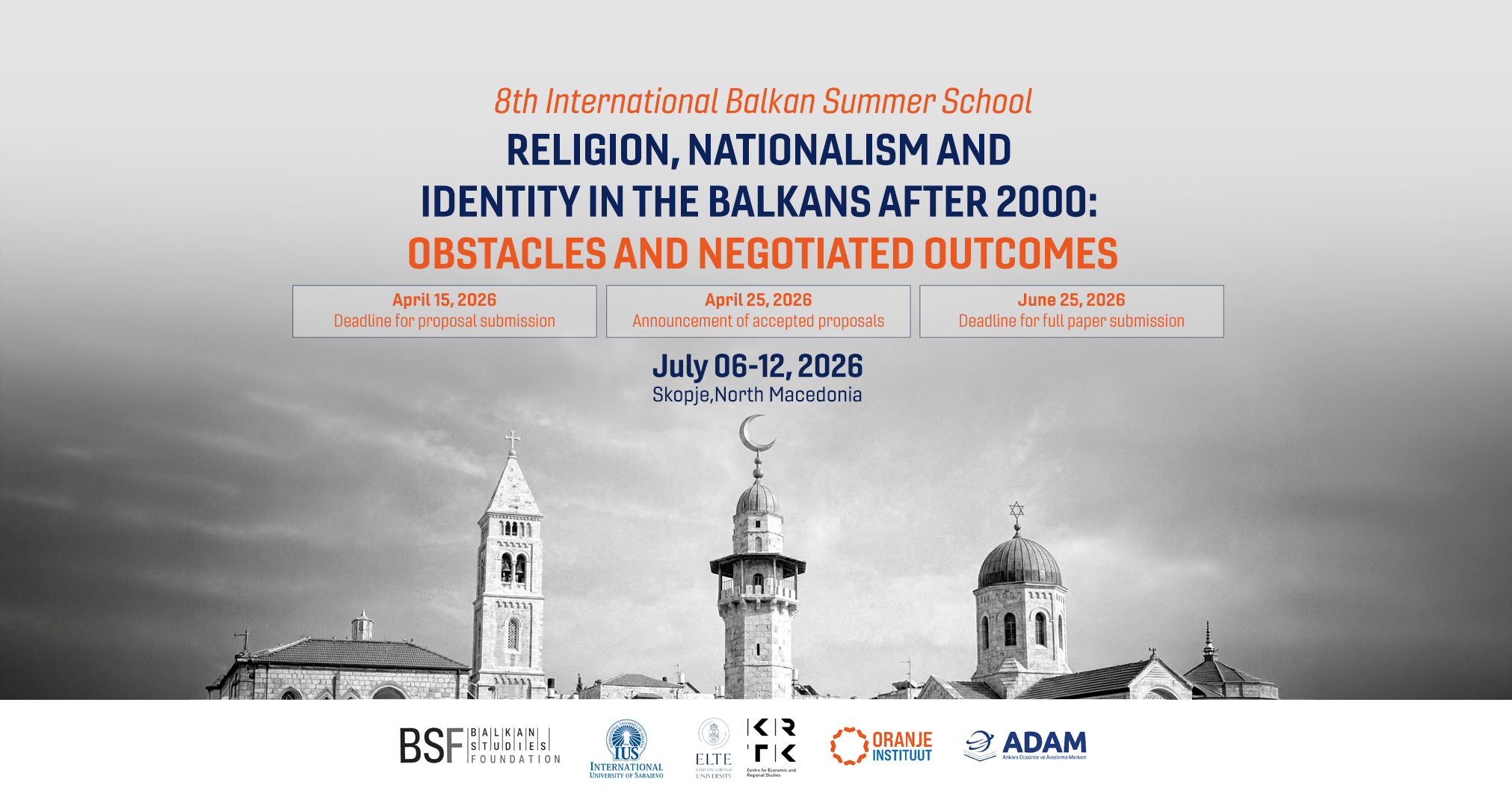
The International Balkan Summer School, titled “Religion, Nationalism, and Identity in the Balkans after 2000: Obstacles and Negotiated Outcomes”, scholars and researchers to explore the complex intersections of religion, nationalism, and identity in the post-2000 Balkans. Through experts, lectures, interactive panels, and workshops, participants will examine key challenges such as ethno-religious, migration, memory politics, and state-building processes. The program combines rigorous methodological training with interdisciplinary discussions across political science, sociology, history, anthropology, and international relations, offering participants a comprehensive understanding of the region’s ongoing transformations. Designed for postgraduate students, doctoral candidates, and researchers, the summer school provides advanced analytical tools, practical skills in academic writing, and invaluable networking opportunities with leading scholars and policy experts. By joining, participants gain a deeper perspective on the obstacles, negotiation processes, and evolving outcomes shaping contemporary Balkan societies, while contributing to critical scholarly debates in the field.
Program Highlights
- Expert-Led Lectures on post-2000 transformations of religion, nationalism, and identity in the Balkans.
- Thematic Panels addressing key obstacles such as ethno-religious tensions, memory politics, migration, and state-building.
- Case Study Workshops focusing on selected Balkan countries and comparative regional perspectives.
- Methodology Sessions on qualitative, archival, discourse, and field research related to identity and nationalism studies.
- Interdisciplinary Dialogue bringing together political science, sociology, history, anthropology, and international relations.
- Networking Opportunities with scholars, policy experts, and fellow researchers.
- Publication & Academic Writings (journals, edited volumes, conference papers)
- Certificate of Participation upon successful completion.
Target Audience
- This program is designed for postgraduate students, doctoral candidates, and researchers working in fields such as political science, international relations, sociology, anthropology, history, and Balkan studies. Participants are expected to possess a solid academic foundation and a strong interest in critically examining the complex interactions between religion, nationalism, and identity in post-2000 Balkan societies.
- Through interdisciplinary discussions and expert-led sessions, participants will explore key obstacles, negotiation processes, and evolving outcomes shaping the region. By joining this program, attendees will gain advanced analytical perspectives, build meaningful academic networks, and contribute to scholarly debates on the contemporary transformations of the Balkans within a broader global context
Application and Review Process
Participants are required to submit an article addressing the summer school’s thematic focus. All submissions undergo a rigorous blind peer review process to ensure the highest academic standards. Abstracts and full texts are evaluated by field experts, and only those meeting the established criteria are accepted. This process underscores the school’s commitment to fostering excellence and originality in academic inquiry. The papers chosen at the end of the Summer School will be published by the Balkan Studies Foundation in order to admit the presentations taking place at the Summer School to the scientific world.
Deadline for proposal submission April 15, 2026
Important Dates
April 15, 2026
Submission
Deadline for Proposal Submission
April 25, 2026
Announcement
Announcement of Accepted Proposals
June 25, 2026
Submission
Deadline for Full Paper Submission
July 01, 2026
Announcement
Announcement of the IBSS Program
July 06-12, 2026Monday-Saturday
Implementation
Implementation of the IBSS
November, 2026
Publication
Publication of the selected papers
Boards
Honorary Board of the Summer School
Balkan Studies Foundation President, Assist. Prof. Dr. Sevba Abdula
International University of Sarajevo, Prof. Ali Osman Kuşakcı
ELTE Centre for Economic and Regional Studies, Dr. Ferto Imre
Oranje Institute President, Dr. Ali Eşlik
Ankara Center for Thought and Research, Prof. Dr. Mehmet Bulut
Organizing Institutions
Balkan Studies Foundation
International University of Sarajevo
ELTE Centre for Economic and Regional Studies
Oranje Institute President
Ankara Center for Thought and Research
Organizing Committee
Assoc. Prof. Dr. Bujamin Bela – Mother Teresa University, North Macedonia (Chairman of the Board)
Assist. Prof. Dr. Sevba Abdula, Balkan Studies Foundation, North Macedonia
Assoc. Prof. Dr. Admir Mulaosmanovic, Bosnia-Herzegovina
Assoc. Prof. Dr. Cem Korkut, Ankara Yıldırım Beyazit University, Türkiye
Assist. Prof. Dr. Ahmet Köroğlu, Istanbul University, Türkiye
Dr. Ferto Imre, ELTE Centre for Economic and Regional Studies, Hungary
Dr. Ali Eşlik, Oranje Institute, Netherland
Dr. Mustafa Işık, Bulgaria
Hanife Etem, Balkan Studies Foundation, North Macedonia
Scientific Committee of the Summer School
Assist. Prof. Dr. Abdullah Muhsin Yıldız, Yalova University, Türkiye
Dr. Adnan Mestan, International University of Sarajevo, Bosnia and Herzegovina
Assoc. Prof. Ali Erken, Marmara University, Türkiye
Assist. Prof. Dr. Drita Memedi, State University of Tetovo, North Macedonia
Dr. Besnik Emini, Institute for Spiritual and Cultural Heritage of Albanians, North Macedonia
Prof. Dr. Bejtulla Demiri, International Balkan University, North Macedonia
Assoc. Prof. Dr. Bujamin Bela, Mother Teresa University, North Macedonia
Dilek Kütük, Istanbul Medeniyet University, Türkiye
Assist. Prof. Dr. Elmin Aliyev, Istanbul Medeniyet University, Azerbaijan
Assist. Prof. Dr. Elisabeta Bajrami Ollogu, Mother Teresa University, North Macedonia
Assoc. Prof. Idlir Lika Idlir, Ibn Haldun University, Türkiye
Assist. Prof. Dr. Kadir Temiz, Istanbul Medeniyet University, Türkiye
Prof. Dr. Mehmet Bulut, Istanbul Zaim University, Türkiye
Assoc. Prof. Dr. Mevludin Ibishi, International Balkan University, North Macedonia
Assist. Prof. Dr. Mehmet Uğur Ekinci, SETA, Türkiye
Assist. Prof. Dr. Murat Aliu, Mother Teresa University, North Macedonia
Assoc. Prof. Dr. Neritan Turkeshi, Mother Teresa University, North Macedonia
Assist. Prof. Dr. Nikola Dacev, International Balkan University, North Macedonia
Assist. Prof. Dr. Ramazan Turgut, Oranje Institute, Netherland
Assist. Prof. Dr. Sedad Beslija, University of Sarajevo, Bosnia and Herzegovina
Assist. Prof. Dr. Süleyman Güder, Istanbul University, Türkiye
Assoc. Prof. Dr. Zećir Ramčilović, Ss. Cyril and Methodius University in Skopje, North Macedonia
Rules for Writing
Proposal guidance
- Proposals must be in English and submitted to https://forms.gle/ZoNHKoPgvu4QoqX47 Google form and and must be between 2000 words in length.
- Provide an overview of your research question, explaining why it is of academic and or practical importance
- Outline the main objectives of your research, providing details of two or three key aspects
- Write a short literature review, indicating the importance of previous related research or investigated literature and how your own research question might make a useful contribution to the area
- State the main research techniques (interviews, case studies, modelling etc.) you might use
- Indicate your suggested data collection procedures, indicating sources and any possible difficulties
- Explain any analytical techniques you intend to use
- State your proposed timetable of activities
- Finally, list the references in your proposal or provide a short bibliography.
Some of the common problems
In our experience, there are a number of common reasons why proposals from well qualified potential students are rejected.
Some common problems are outlined below:
- Your research topic is inadequately specified. You must write to a very tight format stating what you plan to research, why and how. The format is clearly outlined above.
- Whilst your proposal may identify a practical managerial problem it does not demonstrate its analytical importance. A study that merely aims to discover new empirical information or simply solve a current issue will probably not be accepted. Your proposal must engage with controversies, new ideas/thought and demonstrate strong critical insight into one or more academic disciplines to succeed in your research.
The format of your Research Proposal
Your proposal should be a maximum of 2,000 words, in addition to your timetable and references or a short bibliography.
Procedure / Rules of Writing
- Accepted proposals will be invited to submit their full manuscripts to the International Balkan Summer School. The submitted papers (full texts) must be original works that have neither been previously published nor are currently under consideration for publication elsewhere.
- Abstracts must be in English and submitted to Google form and must be between 250 and 350 words in length.
- The study should contain between 5,000 to 8,000 words.
- The full text must be submitted in Microsoft Word format by June 25, 2026. Texts uploaded in PDF format will not be accepted.
- Full texts not prepared in accordance with the Rules of Writing of the IBSS will be rejected without being sent to the reviewers.
- The articles to be submitted to the IBSS should be written in Microsoft Word program with at least 2.5 cm margins, and the entire text should be written in Times New Roman font, font size has to be 12 and 1.5 line spacing. The name of the article should be written in capital letters, bold font and size 14, while the subtitles should be written in lowercase font and size 12.
- In the articles, after the name of the author, in the footnote with an asterisk (*) symbol, the title of the author, the university/department and the mail address must be written in full. ROR ID and ORCID NUMBER.
- Tables and tables should be numbered sequentially. Footnotes for tables should be added just below the table body and should be indicated in lowercase. Care should be taken to use as few tables as possible. The data presented in the tables should be avoided to match the data presented in the text.
- Footnotes, abstracts, bibliographies, tables, etc. should be completed before the article is delivered.
- In the introduction part of the article, the subject, thematic, temporal and spatial boundaries of the article should be specified. Also, it should include information such as the importance of the article, the space it fills in the field, the new perspective it brings, and the information it corrects. In addition, the methods and sources used, the main claim, and the side claims supporting it should also be included.
- The full texts submitted after assessing the abstract will be subjected to a preliminary examination by the Regulatory Board in terms of form and content, after which it will be sent to the reviewers. The following decisions may be given for the studies in line with the reports coming from the reviewers:
Acceptable in its current state.
Can be accepted into the Summer School after correcting the issues stated in the review evaluation.
Rejected.
- APA 7th edition will be used as the article reference system.
Matters to Consider When Presenting the Paper
Holding a successful and efficient The International Balkan Summer School depends on the contents of the papers as well as the success of their presentations. Presenting papers in order, with discipline, on time, and with success is very important. The following guidelines have been created to help you with your presentation.
Session and Paper Durations
The International Balkan Summer School will consist of 4-5 announced sessions, each lasting 90-100 minutes.
A total of 15 minutes will be allowed for each presentation. Strict compliance with this duration is of utmost importance. The functioning of the symposium according to schedule depends on complying with these durations.
The time remaining after the papers have been presented will be used for evaluations, comments, criticisms, and answering questions from the audience.
Meeting
One chairperson will lead each session. The chairperson will be in the hall prior to the session and will meet the speakers who will make a presentation. Each participant must be in the hall 10 minutes prior to the session and must check their presentation.
Presentation and Presentation Materials
The presentation must be carefully prepared so that it can be completed within the allowed time.
Only the main points of the paper that have been prepared in the presentation should be discussed. Details can be read from the proceedings book, or further discussions with relevant stakeholders can be continued during the intermission after the presentation.
Each hall will have a projector and a computer for the presentations. Because these computers are the ones to be used for the presentations, the presentation must be uploaded to the computer in the respective hall in advance (e.g., the morning of the day of the presentation). Hall attendants may be consulted for support on technical issues related to the presentation.
Using short sentences (2-4 words) and a large font size (at least 24 point) on the slides is important in terms of following up the presentation.
A maximum of 15 slides should be prepared for a 15-minute talk. Make sure the presentation can be completed within 15 minutes by experimenting beforehand. A sample structure for an oral presentation
SUMMER SCHOOL TOPICS
The International Balkan Summer School will be able to cover all sub-disciplines of the social sciences focused on the Balkans region. Some of the topics to be addressed at the congress may appear as but are not limited to the following:
- Religion and politics in post-2000 Balkan societies
- Nationalism, nation-building, and state legitimacy
- Identity formation, transformation, and contestation
- Ethno-religious relations and intercommunal dialogue
- Memory politics, trauma, and post-conflict narratives
- Migration, diaspora, and transnational identities
- Minority rights, citizenship, and inclusion policies
- European integration and its impact on identity politics
- Secularism, religious revival, and public space
- Youth, education, and identity socialization
- Gender, religion, and nationalism
- Media, discourse, and representation of identities
- Radicalization, extremism, and prevention strategies
- Reconciliation processes and peacebuilding initiatives
- Cultural heritage, symbolism, and identity preservation
Frequently Asked Questions
Master’s students, doctoral students, or anyone who has completed their master’s and doctorate degrees within the last two years can apply to the Summer School.
Yes, one may participate in the congress with more than one paper, provided that these papers comply with the announced subjects. However, one author may present a maximum of two papers at the Summer School.
No. Undergraduate students may only participate in the Summer School as audience members.
Anyone who meets the conditions (i.e., transportation, accommodations) can participate in the audience regardless of whether or not they have an academic education. Please note, the congress provides no support for audience members.
The relevant parts of the site state the features that will be considered for the papers at the International Balkan Summer School. Other unmentioned issues are the conditions that an academic paper must meet. On this point, support for papers can be obtained from academicians or people who are knowledgeable in regard to academic writing.
Participating in the Summer School is free. Participants’ accommodations, breakfasts, and dinners will be covered by the Symposium’s organizing committee. A free tour of the city will be offered to the Summer School participants after sessions have been completed. Transportation to the Summer School will be at the participant’sown expense (not covered). Presentations at the Summer School will be held from 14 July to 18 July; the city tour will occur on Saturday, 19 July. Flight or bus tickets should be determined by taking these dates into consideration.
The congress will accept papers and presentations only in English.
Partners/Sponsors
A huge thanks to all our amazing partners.





Join Our Community
Feel free to reach out to us via our social profiles